


Most people think sleep begins at night.
It doesn’t.
Or at least, good sleep doesn’t.
It begins much earlier. It begins when morning light hits your eyes and tells your brain what kind of day this is going to be.
Bright. Cloudy. Short. Long. Winter. Summer. Near the equator. Far from it. That first light is not just scenery.
It is timing information.
Your body reads it. Then it starts making decisions that will matter 12 to 16 hours later, when the sun drops, and you want to feel naturally sleepy.
That is the part most people never hear.
You hear about prescription drugs. Antihistamines. Melatonin. Valerian root. Blackout curtains. You hear a thousand nighttime tips.
But nobody explains the deeper idea:
Your body begins preparing for the night at sunrise.
And once you see that, a lot starts to make sense.
If you don’t feel sleepy after sunset… if you feel wired when you want to feel calm… if your body seems confused about when to power down… the problem may not begin at 10:00 PM.
It may begin with the light you missed at dawn.
If you want to feel sleepy naturally after sunset, you have to see the sunrise.
This isn’t woo. This is physics. Your body has an internal timing system. Scientists call it the circadian system. Light and darkness are its biggest signals.
The National Institute of General Medical Sciences says light and dark have the strongest influence on circadian rhythms, and the National Heart, Lung, and Blood Institute (NHLBI)explains that the sleep-wake cycle is shaped by this light-dark pattern. Melatonin does not rise randomly. It follows that timing system.
In plain English, your brain is not asking,
“What time does the clock say?”
It is asking,
“What is the light telling me?”
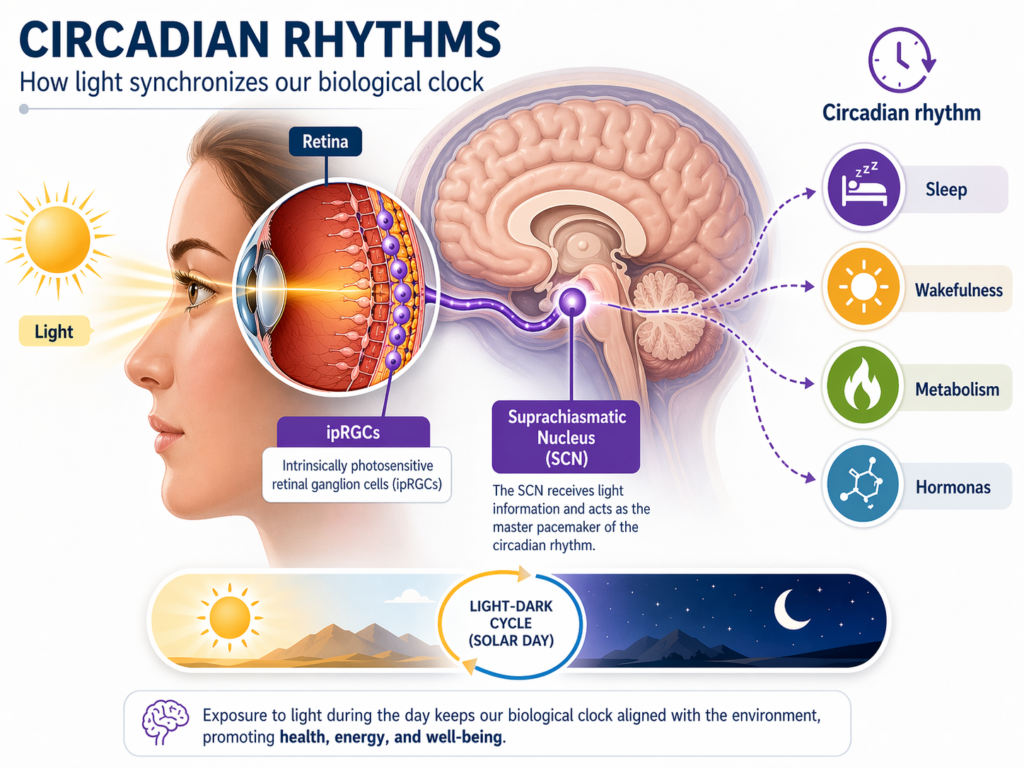
That signal begins in the eyes. Special retinal cells called intrinsically photosensitive retinal ganglion cells, or ipRGCs, respond to light and send timing information to the brain’s master clock, the suprachiasmatic nucleus (SCN). These cells are especially important for circadian entrainment, which is the process of syncing your internal clock to the solar day.
So, when morning light reaches your eyes, you are not just “waking up.”
You are resetting your internal clock.
That is why the first part of the morning matters so much. Research on the human light phase-response curve shows that light in the morning shift circadian rhythms earlier, while evening light tends to shift them later. What this means is, morning light helps move your sleepiness earlier. Evening light pushes it back.
That’s the twist most people miss.
They think darkness creates sleep. But darkness is only half the story. Morning light helps determine when darkness will feel sleepy to you.
The Missing Piece of the Puzzle: The Sunrise
Imagine two people.
One person wakes up and steps outside at sunrise. The other wakes up under dim indoor lighting, drives to work in a shaded car, and spends the first half of the day under office lights.
Both are technically “awake.”
But biologically, they are not giving their brains the same message.
Natural daylight is dramatically brighter than most indoor environments.
And we also know that living under natural light–dark cycles can shift circadian timing earlier compared with life under artificial light. In a Current Biology study, researchers tracked light exposure and measured the participants internal clock using melatonin timing. Before the intervention, people lived normally, exposed to artificial light during the day and after sunset. Then the same participants spent a week camping with only natural light (no electric lighting). After that week, their circadian timing shifted about ~2 hours earlier, with melatonin turning on and off earlier. That means their biological night moved earlier, closer to the natural solar day.
The takeaway is simple: modern indoor light environments delay our internal clock, while natural outdoor light and dark pulls it earlier.
That helps explain why someone can feel tired all day yet still not feel sleepy at the right time at night.
Their body got poor light information.
But there is an irony in all of this. The problem is not only too much light at night…
It’s too little natural light during the day!
That’s why a major expert consensus paper on healthy lighting recommends bright days and darker nights because the same circadian system that uses daylight to anchor timing is also vulnerable to evening and nighttime light.
This is exactly what we saw in the study above: ordinary evening room light delay melatonin release and shorten melatonin duration.
So if your mornings are dim and your evenings are bright, you are pushing on the clock from both sides.
You are whispering “night” all day long and then shouting “day” at 10 PM.
No wonder the system gets confused.
Why the First 15 Minutes After Sunrise Matter Most
In a nutshell…
The first stretch of light after sunrise matters because it is the opening signal of the day’s light story.
Morning light soon after waking is essential for circadian timing. In fact, many studies and clinical protocols use morning sunlight exposures of around 30 minutes or longer for benefits like better sleep, mood, and alertness.
So think of “the first 15 minutes after sunrise” as a biological necessity.
There is no alternative.
Catch the day at sunrise. Let your eyes see real morning light. Give your clock a strong signal while the signal is there.
This Is How Nature Does It
Picture a bird at dusk.
No one needs to hand it a sleep tracker. No one needs to prescribe it a pill. No one needs to explain “sleep hygiene.”
The light changes, and the bird respond.
Humans are more complicated, yes. We have screens, streetlights, shift work, deadlines, LED kitchens, and bedrooms that never get truly dark. But under all that noise, the old system is still there. Your nervous system still expects a bright day and a dark night. It still tries to measure sunrise and sunset. It still uses light to decide what should happen next.
That is why this idea lands so hard for people who have felt confused for years.
Because it replaces self-blame with a real explanation.
Not: “Why am I so bad at sleeping?”
But: “What signals has my body been getting?
That question changes everything.
Try this tomorrow.
Do it for a couple of days and notice what happens:
Go outside barefoot at sunrise. Let your feet touch the earth, and let your eyes take in the early morning light as the sun rises on the horizon. At that hour, the light is softer, and you can comfortably watch the sunrise.
The barefoot part is important because you need to be grounded to absorb light better.
As the morning light strengthens and the first rays of ultraviolet light (UV-A) begin to appear, don’t look straight at the sun. Just let your eyes receive the outdoor light safely while you stand barefoot on the earth.
But don’t stop there.
If you want the best result, give your body as much natural light as you can throughout the day. Step outside again later in the morning. Take a short walk at midday. Let your body experience what a bright day really feels like.
That contrast matters.
A bright day tells your body it is daytime. Darkness later tells it night has begun. That is how your timing system becomes clearer.
Then compare that with a day spent mostly indoors under weak artificial light.
Over time, many people notice earlier sleepiness, better daytime alertness, and a clearer sense that their body knows when it is day and when it is night.
That is testable.
Not mystical. Testable.
Resources
1. National Institute of General Medical Sciences. “Circadian Rhythms.”
2. Intrinsically Photosensitive Retinal Ganglion Cells.
3. A Phase Response Curve to Single Bright Light Pulses in Human Subject
4. Entrainment of the Human Circadian Clock to the Natural Light-Dark Cycle
6. The Dim Light Melatonin Onset Across Ages, Methodologies, and Conditions.
9. The Role of Sunlight in Sleep Regulation: Analysis of Morning and Daytime Light Exposure.